

If you had asked Francis Galton’s grandma1 why some people get more education than others, I think she would have said something like, “Well, people are different in their organic constitution, and they are born into different family circumstances, and then those two things mix together in very complicated ways as people grow up. People aren’t raised under controlled conditions, which makes the two ingredients basically impossible to separate.” Let’s call Grandma Galton’s account the default naive hypothesis.
Once Grandma’s other grandson, Charles, focused the idea of “constitution” with the revolutionary theory of evolution and genetics, grandson Francis Galton found the default naive hypothesis (henceforth DNH) unsatisfactory in two ways. The first— the methodological problem— is that the DNH is scientifically squishy: what scientist would be satisfied with the idea that genetic and environmental contributions to educational attainment (EA) are both important in a general way, but hopelessly intertwined, inseparable and unquantifiable? [My book has Nature and Nurture in the title, so the most common question is OK haha, which is it? As I launch into a description of the DNH I can feel their eyes glazing over.]
Galton’s second impulse— the ideological problem— was that the constitutional/evolutionary/genetic component to educational differences was larger than Grandma assumed, so a lot of social inequality that was naively attributed to sociology was probably more a matter of genetics and evolution. The history of behavior genetics is a continuing process of pointing different methodological tools at the DNH and seeing what happened.
Galton invented a research program in attempt to solve the methodological problem in the service of the ideological problem. He aggregated educational attainment (or a generalized version of it he called “eminence”) in families, and found that it clustered reliably. But of course that confounded genetic and environmental similarity. So the twin study was invented (partly by Galton, fully worked out by others) as a means of controlling family environmental effects. Heritability was invented as a 0-1 solution to the methodological problem. Thousands of papers were written promising to “disentangle” nature and nurture.
When twin studies were pointed at the DNH, they suggested large if poorly specified genetic effects, which all in all seemed to vindicate Galton’s ideological hypothesis. Heritability coefficients for EA in particular were generally around 50%. Arthur Jensen thought the heritability of IQ was .8; The Bell Curve was written on the assumption that it was .6.
But there are a lot of problems with twin studies, all of which come down to the fact that they are poorly specified genetically, and don’t really solve Galton’s methodological problem of “disentangling” nature and nurture. That’s an old story. But then, just in the nick of time, a new tool came along: The Human Genome Project, which for the first time allowed behavior genetics to be based on real DNA. The field spent a decade pointing this new tool at the DNH, hoping to find the genes that cause educational differences, but once again it didn’t work. Genes obviously had something to do with all this complexity, but the attempt to boil it down to the main effects of individual alleles was a failure.
Then, again just in the nick of time, GWAS was invented, and things started to look up. A series of four papers, commonly called EA1,2,3 and 4, used ever more sophisticated genomics in samples crossing into the millions. Tiny, statistically significant associations with individual bits of DNA were identified, but the effects were tiny and lacked any obvious biological relevance. Grandma Galton’s DNH still held true.
But those tiny genetic associations could be aggregated, offering a new way to estimate heritability coefficients called SNP heritabilities, and better yet to provide concrete “polygenic scores” (PGS) that could be used as real-world genetic predictors of EA. And the results, while not exactly at Arthur Jensen levels, looked promising! By the time EA4 came along, the R2 for the PGS was up around 15% ! The following is from Okbay et al (2022).
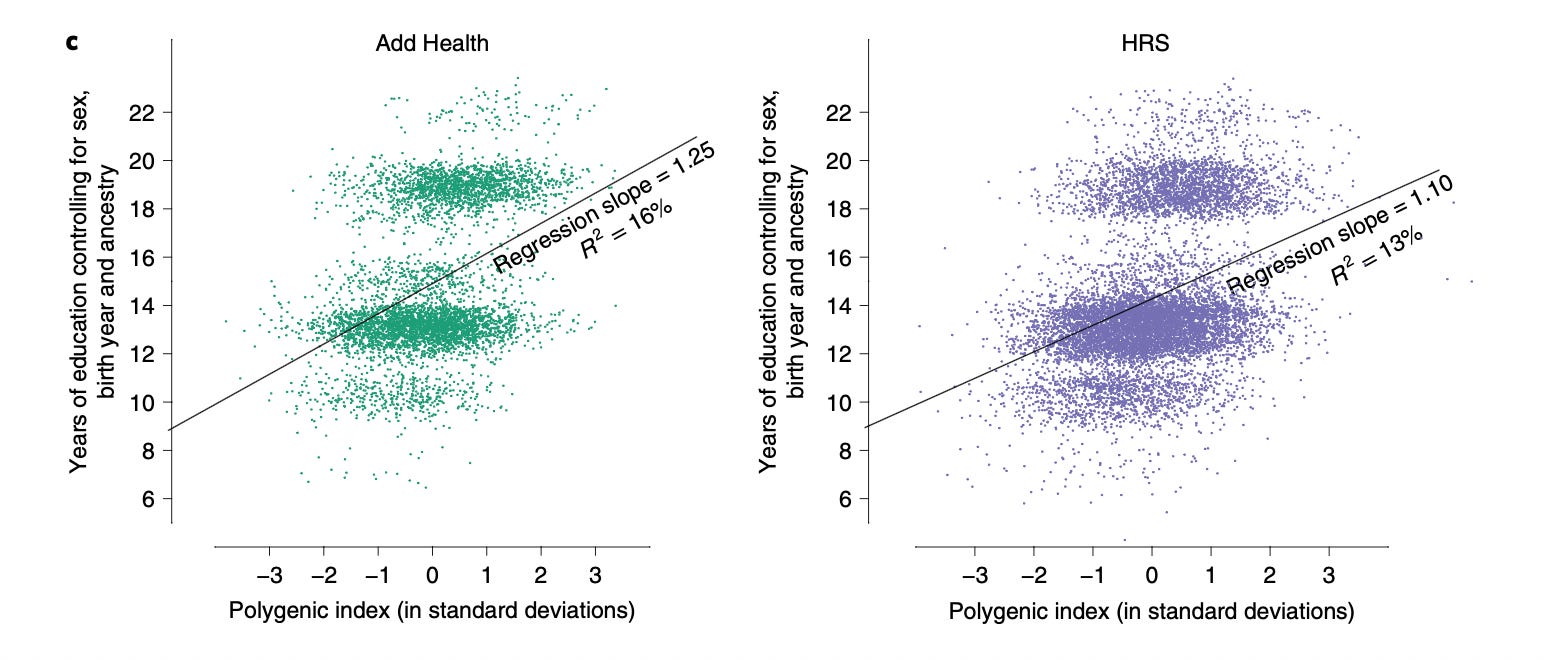
It turns out, however, that those PGS have exactly the same problem that Grandma Galton identified. People in different families are exposed to different environments in a million poorly specified ways. If rich people, for whatever reason, have different gene frequencies than poor people, and educate their kids in high quality schools, then those are going to look like EA genes and wind up in the EA PGS. Once again this is is familiar and I won’t elaborate.
But wait. It turns out that modern genomics offers us the possibility of studying genetic differences within families instead of just between them, in the process controlling for many of the confounds that worried Grandma Galton. Moreover, as Paige Harden pointed out, meiosis assigns genes more or less at random within families, producing something resembling a randomized clinical trial. Now, finally, we can crack Grandma Galton’s DNH and get some real genetic causation.
OK that went on too long, I know you have heard it from me before. But now we have Jaishankar et al., the et al including a list of luminaries in quantitative and social science genomics. The paper describes a new method called Genomic-Relatedness-Matched Association (GRMA), which uses extended family information within a GWAS structure to identify SNP heritabilities and PGS while controlling for most of the between family and ancestral variables that confound them in ordinary GWAS. As I always say in posts like this, I have no criticism whatsoever of the method, and would not be qualified to make one even if I wanted to. I accept it at face value. Human statistical genetics has reached extraordinary levels of sophistication.
But what, you may ask, does the study find? The report trains a laser focus on methodological questions, with the peculiar result that it maintains much more interest on the standard errors than on the parameters themselves. Those standard errors are indeed smaller, and allow the investigators to estimate a few esoteric quantities (like the genetic correlation between EA and BMI) that could not be estimated otherwise.
As usual, to find the actual results, by which I mean the beta2 or R2 values for the PGS as within family predictors of EA, you have to dig into the supplemental tables. (The beta2 and R2 values move around a little and don’t always agree with each other, I think for the usual Snijders and Bosker reasons: Variance explained metrics are tricky in multilevel models, because adding between- and within-predictors change both the numerator and denominator of variance ratios.).
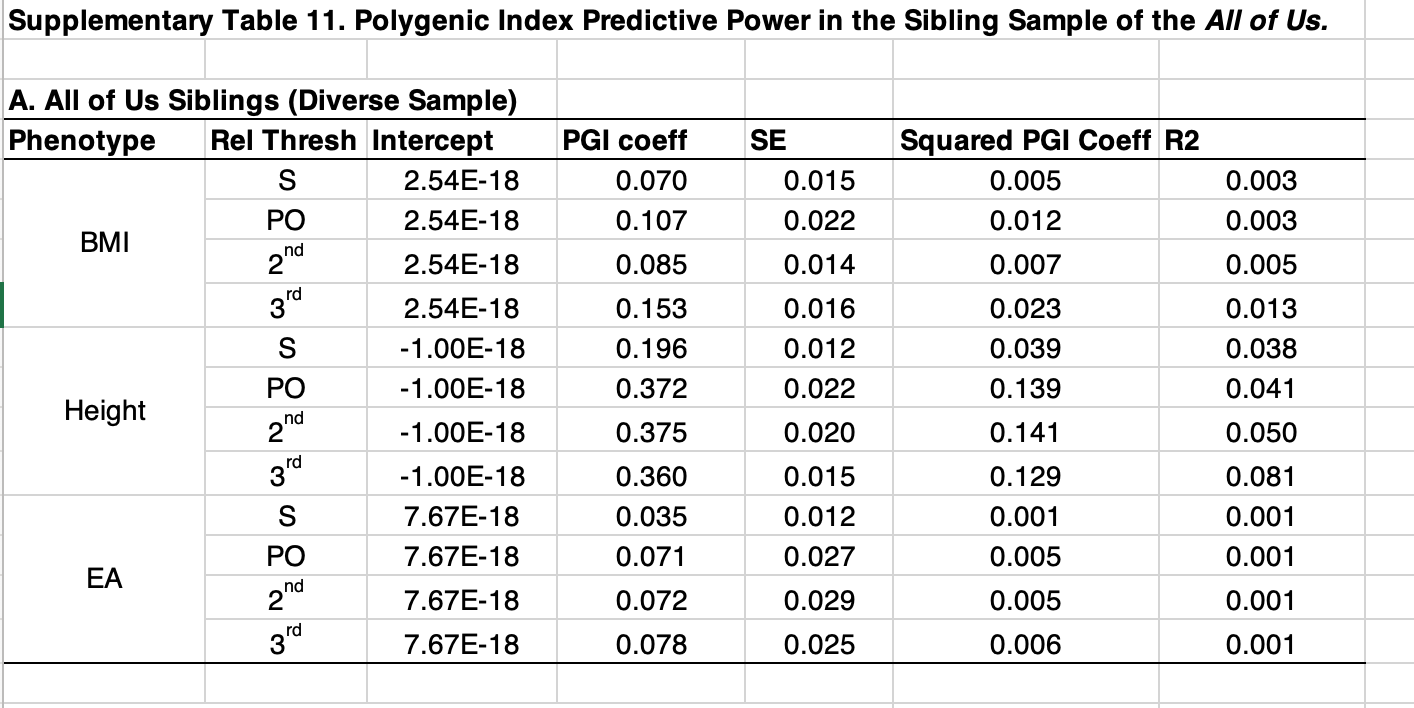
The bottom line is in the right hand column. The purported meiotic randomized trial instantiated by the PGS accounts for one tenth of one percent of the variance in EA. (Maybe the squared beta is better here, I’m not sure, but none of those reach 1% either.) I have harped on this before, I don’t need to do it again, but it is truly amazing: the authors don’t even remark on their own finding. All of the genomic enthusiasm for the first four versions of EA — the steadily increasing effect sizes, the gene finding, the biological annotation, the practical applications— has been washed down the drain, and no one seems to care enough to note its passing.
Two-hundred years later, it turns out Grandma Galton was right. The default naive hypothesis is true, and that is all there is. High MZ twin correlations, SNP hits for behavior, statistically significant results for PGS: none of them are evidence that the world has turned out to be any more genetic than Galton’s Grandma thought; they are no more than what the Default Naive Hypothesis looks like when examined through different methodological lenses. It’s all just normal, squishy, uncontrolled human development. Genes and environment both “make a difference” for educational attainment in some general and unsatisfying way, but all attempts to identify either one as causal main effects wind up reducing them to zero. (It happened to the environment 25 years ago. See Turkheimer & Waldron, 2000)
I think this is good news, something to be celebrated rather than swept under the rug. Galton’s methodological problem turned out to be insoluble, which is too bad for social scientists, but the payoff is that we don’t have to worry about his regressive ideological convictions. The gloomy prospect always wins, and humanity is better off for it.
From Doc Edge. Obviously not important to the substance of your post, but Darwin and Galton actually didn't share a grandma---they were half-cousins and shared only a grandpa (Erasmus Darwin). My bad… I think I will leave the post as is, for now.
Here's a question: Say a married lesbian couple really wants a baby. They go to a sperm bank and get the catalog of donors. Should they just pick some donor at random to not waste their time?
But what about the other side of the coin of the Missing Heritability: the Missing Malleability?
The underlying progressive assumption behind huge amounts of government spending since LBJ's Great Society has been that the government can improve children by spending money to improve their environments.
Some programs worked as hoped: getting rid of Jim Crow schooling in the South helped, as did regulating the emissions of lead smelters.
But since the Coleman Report of 1966, a general pattern has been that good social science has uncovered a decidedly Gloomy Prospect about malleability. In general, after 60 years, the government has yet to figure out what really works, especially to narrow gaps in performance between socially and politically salient groups.